
FAQ
Pipe and Tube Bending Basics
What Is a Pipe and Tube Bending Machine?
A pipe and tube bending machine is a metal forming machine that bends pipes and tubes into specified angles and radii using forming dies, pressure, and controlled movement. Depending on the machine configuration and application, common bending methods include rotary draw bending, compression bending, roll bending, and mandrel bending.
CNC pipe and tube bending machines coordinate feeding, rotation, and bending to produce accurate, repeatable parts. Machine selection depends on the tube material, outside diameter, wall thickness, bending radius, bend angle, production volume, and tooling requirements.
7
Industries served
38 mm
Maximum tube outside diameter
2 mm*
Maximum wall thickness
5
Servo-driven CNC axes
R15–R150 mm
Bending radius range
150+
Countries served
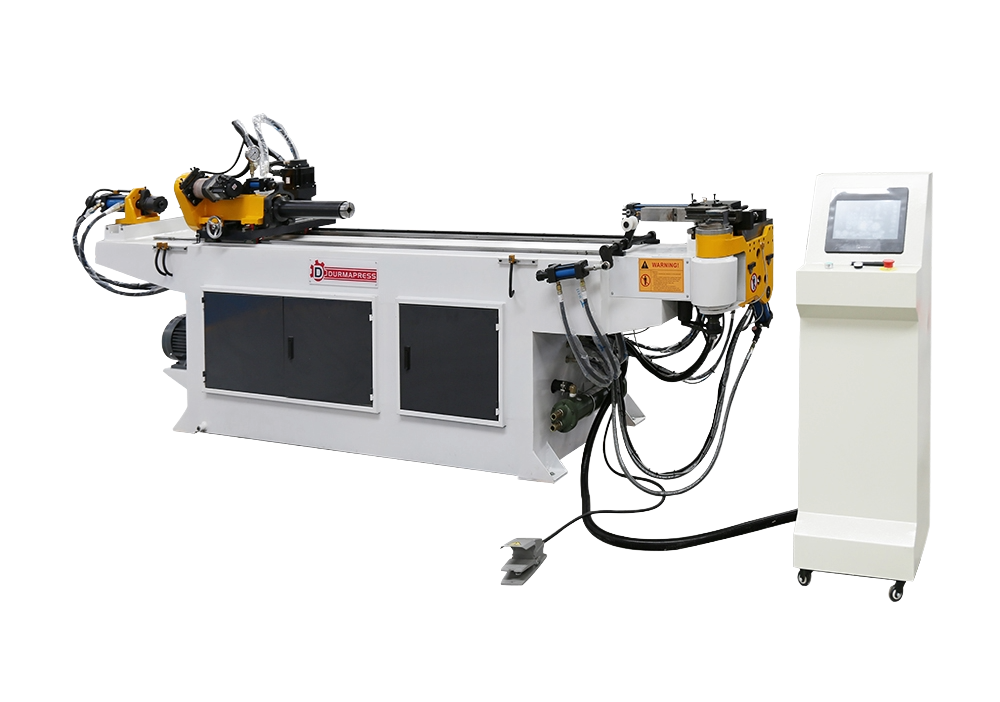
DPTB — Versatile 5-Axis Tube Bending Solutions
Frequently Asked Questions
Get answers to common questions about Pipe and Tube Bending Machine and DPTB
What tubes can the machine bend?
The DPTB YT-38CNC-5A-2/3S is designed for carbon steel, stainless steel, aluminum, and copper tubes from Ø10 to Ø38 mm, with a maximum listed capacity of Ø38 × 2 mm.
What bending radius can it achieve?
The YT-38CNC-5A-2/3S has a listed bending-radius range of R15 to R150 mm. The actual result depends on the tube material, dimensions, and tooling.
What tooling does tube bending require?
A typical setup may include a bend die, clamp die, pressure die, wiper die, and mandrel. The tooling must match the tube profile, diameter, wall thickness, and bending radius.
Can I cut or drill the tube before bending?
This may be possible, but holes and slots near the bend area can deform. Provide a drawing or 3D file so the feature locations can be reviewed before production.
What information is needed for a quotation?
Please provide the tube material, outside diameter, wall thickness, bending radius, bend angles, bend sequence, straight lengths, quantity, and a 2D drawing or 3D model.
How is bending accuracy controlled?
Accuracy depends on the CNC axes, tube quality, tooling alignment, calibration, and material springback. The YT-38CNC-5A-2/3S uses five servo-driven axes with closed-loop encoders.
How do I choose the right machine?
Consider the tube material, outside diameter, wall thickness, bending radius, bend angle, number of bends, and production volume. These factors determine the required machine capacity and tooling.
When is a mandrel needed?
A mandrel is commonly used for thin-wall tubes, tight-radius bends, or applications that require better control of inside-diameter deformation.
Can it make multiple bends and radii?
Yes. The YT-38CNC-5A-2/3S uses five servo-driven axes and optional double- or triple-stack tooling for complex multi-radius parts.
How much straight length is needed?
The required straight length depends on the clamp, pressure die, mandrel, tube diameter, and bend sequence. Short distances should be checked during tooling design.
Should I choose a manual or CNC bender?
Manual or semi-automatic machines may suit simple bends and small production runs. CNC machines are more suitable for complex parts, repeat production, and higher accuracy.
How can I prevent wrinkles and deformation?
Use suitable tooling, correct mandrel positioning, proper pressure-die support, and appropriate bending speed. The material, wall thickness, bending radius, and tube diameter must also be considered.
Send us a Message
Contact Information
Address
Maanshan, Anhui, China
TEL
+86 0555-8327689
Phone
+86 0555-8327689